
Citizen Scientists Track Fin Whales on Ireland’s Copper Coast
March 25th, 2026
by Martin Möllhoff and Laura Reilly, QuakeShake at DIAS Geophysics.
Sound travels farther in the ocean than light, carrying information across vast distances. Researchers at the Dublin Institute for Advanced Studies (DIAS) are increasingly studying sound and vibration to explore this hidden acoustic world, a theme also reflected in the short film The Sound of the Sea produced by BBC StoryWorks in partnership with Science Foundation Ireland and featuring Prof. Chris Bean, Head of Geophysics at DIAS. The film can be accessed via the list of video links at the very end of this document.
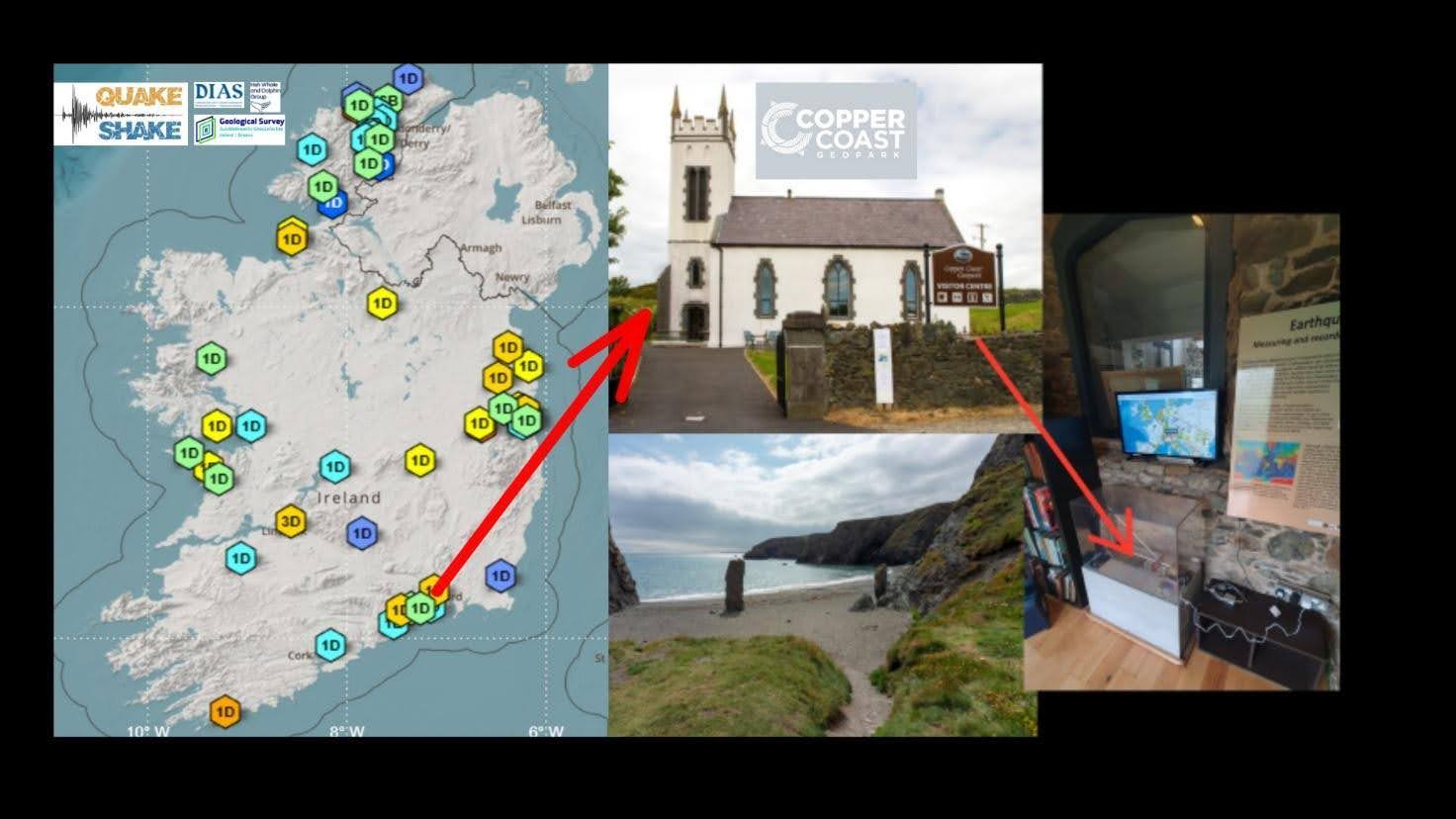
Along Ireland’s southeast coast, this approach took a decisive step forward through QuakeShake, a DIAS public outreach programme. On 2 December 2023, a QuakeShake citizen science seismograph (station RBB07) at the Copper Coast UNESCO Global Geopark in Bunmahon, County Waterford, made the first-ever onshore seismic detection of fin whale song using an affordable plug-and-play Raspberry Shake device (Fig. 1). This breakthrough demonstrated that citizen science seismometers operating on land can capture the deep infrasonic notes (~20 Hz) of the world’s second-largest animal as their powerful vocalizations propagate through the ocean and vibrate the Earth’s crust beneath our feet.
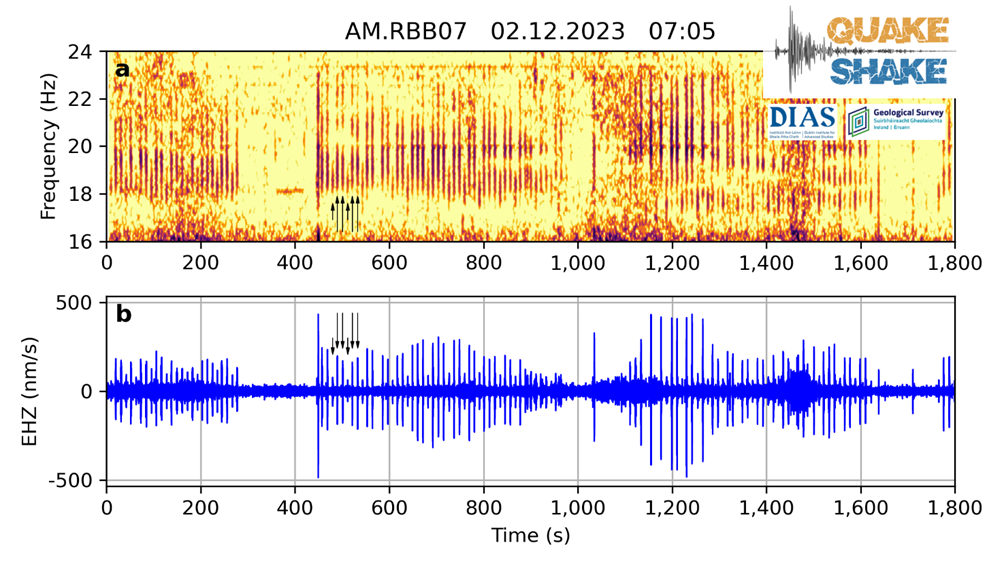
Here’s how the whale call appears on our EQSound App!
The Science Behind the Song
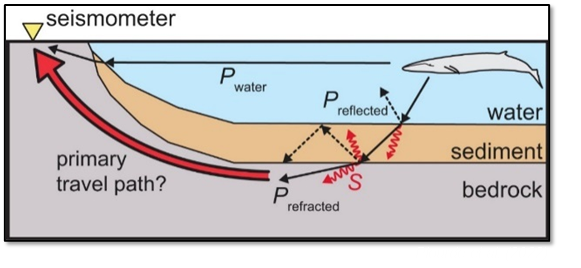
This novel method of recording whale vocalizations was detailed in a 2025 study by Möllhoff and Bean of DIAS, published in Scientific Reports (Möllhoff and Bean, 2025). Their research showed that fin whale notes, among the most intense biological sounds on Earth, travel through the water column and couple into the seafloor as previously shown by Plourde and Nedimović (2022), see also Fig. 2.
Once coupled to the seafloor, these signals propagate as seismic waves through the solid Earth and can be detected by onshore seismometers located up to 5 km inland. The study highlights a key advantage of this approach: terrestrial seismometers are comparatively easy to install, maintain, and connect in continuous real-time streaming mode, offering a cost-effective alternative to expensive underwater hydrophones for monitoring coastal whale activity.
A Christmas Day Surprise
The primary function of a seismometer is to record seismic activity generated by earthquakes. Therefore, the detection of fin whale vocalisations within seismic records was a surprising finding. Following this initial finding, a decision was taken to deploy as part of DIAS’s Irish National Seismic Network (INSN) a more sensitive, professional-grade seismometer (station IBMH) at the former Bunmahon Coast Guard Station in Count Waterford, in order to further investigate the detectability of whale songs.
When examining data recorded at station IBMH on 25 December 2024, a particularly notable event was observed: the INSN detected a magnitude 0.1 earthquake occurring at the same time as a fin whale song, both captured by the seismometer (Fig. 3). It is fascinating to think of a fin whale swimming and singing off the coast of southeast Ireland at the same time that a very small earthquake was occurring!
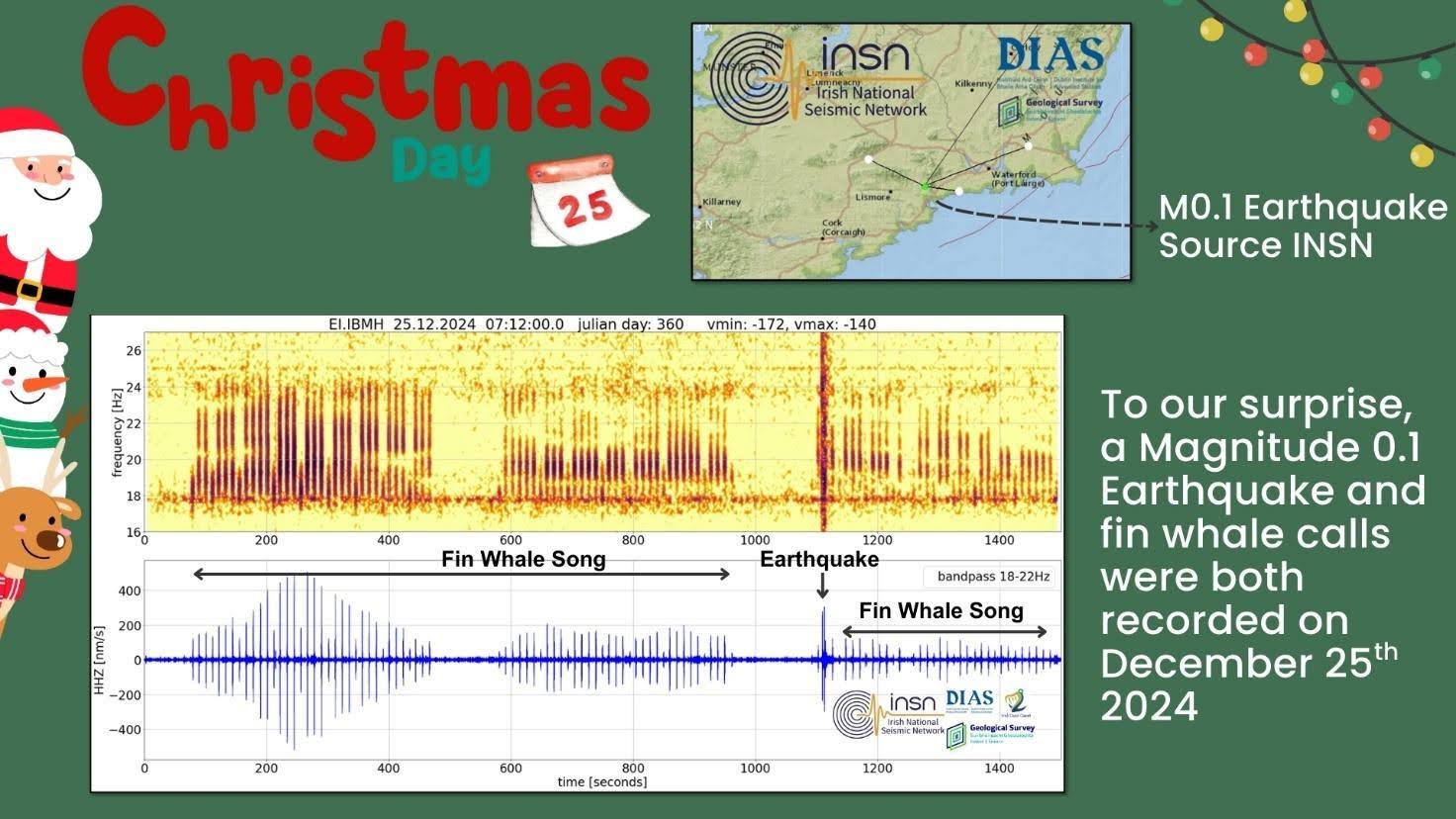
Fig. 3 Simultaneous recording of fin whale notes and a magnitude 0.1 earthquake at seismic station IBMH, operated by the INSN on the southeast coast of Ireland in the former Bunmahon Coast Guard Station in County Waterford, recorded on 25 December 2024.
(Top) Map showing the epicentre location with a green circle and INSN station locations with white circles. (Bottom, top panel) Spectrogram and (bottom, lower panel) corresponding time series of the vertical seismic component (HHZ), band-pass filtered between 18 and 22 Hz. In the spectrogram the prominent vertical brown line just after 1,100 seconds marks the onshore M0.1 earthquake, while the closely spaced, repeating lines represent fin whale notes (brown in the spectrogram and blue in the seismogram).
The QuakeShake Programme: Expanding the Network in 2025
Building on the success of the 2023 and 2024 detections, the QuakeShake citizen science initiative co-financed by DIAS and Geological Survey Ireland, expanded its whale monitoring efforts in 2025. In June 2025, the annual public QuakeShake Meeting was held at the Copper Coast Geopark. As part of the event, several Raspberry Shake seismometers were raffled to members of the public willing to host them within 2 km of the coastline. The goal was to track the seasonal arrival of whales along the Waterford coast, where fin whales are commonly sighted between November and February.
In parallel, QuakeShake partnered with An Taisce’s Clean Coasts and Green-Schools programme to deploy a Raspberry Shake station at a primary school in Stradbally, bringing marine science directly into the classroom. End of November 2025, fin whale songs were indeed detected by this growing coastal network of Raspberry Shake stations across the Copper Coast and surrounding areas, including:
- Helvic Head (Station R8A19)
- Stradbally (Station R7163)
- Bunmahon (Station S24AE)
- Annestown (Station R838C)
These stations recorded the whales’ distinctive rhythmic patterns, consisting of regular 20 Hz pulses (Fig. 4).
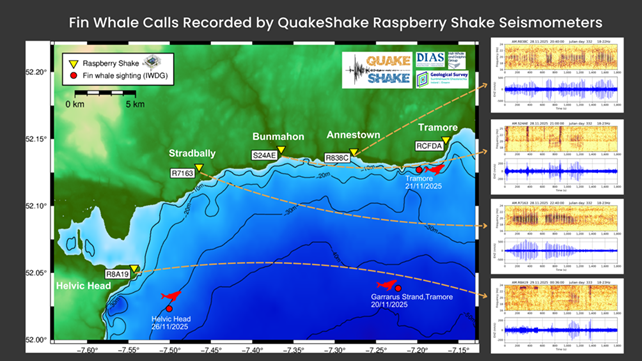
During the same week that these seismic fin whale songs were recorded, fin whale sightings were independently reported to the Irish Whale and Dolphin Group (IWDG) from the same general area along the Waterford coast (Fig. 4). While the sightings did not occur at the exact same times as the song detections, this is fully consistent with known fin whale behaviour. Fin whales typically vocalize at depths of approximately 30 meters rather than at the surface. Also, the seismic signals were primarily detected during evening and nighttime hours, when visual sightings are not possible due to darkness.
New Horizons for Conservation
Fin whales are currently classified as vulnerable (Cooke, 2018), facing ongoing threats from ship strikes, entanglement in fishing gear, and increasing ocean noise pollution. The ability for coastal communities to monitor these animals from their own homes or schools using Raspberry Shake seismometers opens new horizons for marine conservation.
By leveraging real-time seismic data, researchers may develop early warning systems to help protect whales in busy coastal shipping corridors. Over time, the growing archive of citizen-science data could also enable studies of long-term changes in whale migration, behavior, and population dynamics driven by climate change and evolving fishing practices.
The fin whale detections along the Copper Coast in November 2025 stand as a powerful testament to the impact of community-led science, showing how local participation, affordable technology, and global collaboration can help safeguard some of the ocean’s most magnificent inhabitants.
References
- Cooke, J.G. (2018). Balaenoptera physalus. The IUCN Red List of Threatened Species 2018: e.T2478A50349982.
Available at: https://doi.org/10.2305/IUCN.UK.2018-2.RLTS.T2478A50349982.en
(Accessed: 21 January 2026). - Möllhoff, M. and Bean, C.J. (2025). Fin whale song recordings by onshore seismometers open new horizons for cetacean coastal monitoring.
Scientific Reports, 15, 13475.
Available at: https://doi.org/10.1038/s41598-025-97638-4 - Plourde, A.P. and Nedimović, M.R. (2022). Monitoring fin and blue whales in the lower St. Lawrence Seaway with onshore seismometers.
Remote Sensing in Ecology and Conservation, 8(4), pp. 551–563.
Available at: https://doi.org/10.1002/rse2.261
Would you like to learn more?
If you would like to learn more about QuakeShake and DIAS, follow them on social media: Facebook, Instagram, TikTok, YouTube, and Instagram.
Marine Week 2025, Martin Möllhoff: ‘Fin Whale Songs Recorded from Land’
Samhain agus Science 2024, Martin Möllhoff: ‘Fin Whale Whispers Beneath your Feet’
The Sound of the Sea produced by BBC StoryWorks in partnership with Science Foundation Ireland and featuring Prof. Chris Bean, Head of Geophysics at DIAS
https://www.bbc.com/storyworks/blue-horizons/science-foundation-ireland-sound-of-the-sea