
To Catch a Meteor
July 29th, 2026
by: Giuseppe Petricca
When a meteor streaks across the sky, we are all looking, first and foremost, at a beautiful and sometimes mesmerizing light show. The streak usually lasts a second or two (sometimes longer), with any camera that happens to point to the right part of the sky capturing the ephemeral event.
In recent years, probably the most wonder-inspiring video about a meteor atmospheric burn-up that has graced the Internet is the one below, recorded by complete coincidence by user milarefachoo_ on Instagram:
But, did you know that you can “record” a meteor with an infrasound and/or a seismic sensor?
This is because the light streak is not the whole event. If the object was large enough, or disintegrated close enough to the ground, it likely also generated a detectable pressure wave through the air while it was on its way down. The clearest example is the Chelyabinsk meteor that entered our atmosphere over Russia on February 15, 2013. A highly recommended video compilation of what was recorded by dashcams and surveillance cameras available at the time can be watched below:
The light from the meteor was briefly brighter than the Sun, casting its own eerie fast-moving shadows (as can be seen in the compilation), and this phenomenon was visible as far as 100 kilometers (about 62 miles) away.
Beyond this, the meteor also exploded in an air burst at a height of about 30 km (about 19 miles), creating a series of shock waves of varying energy: the first was the most powerful (preceded by a bright flash), followed by a string of smaller ones.
The initial shock wave was so powerful that it was detected as far as 15,000 kilometers away from Chelyabinsk, and it also generated infrasound returns after circling the entire globe several times before completely dissipating.
This particular meteor explosion produced the largest infrasounds to be recorded by the CTBTO (Comprehensive Nuclear-Test-Ban Treaty Organization) monitoring system up to that point since recording began in 2001, and they were only surpassed by the infrasound waves generated by the 2022 Hunga Tonga-Hunga Haʻapai eruption.
These waves, both for such rare but large events and for smaller, more localized ones, can easily be picked up by sensors like the ones we will see in this post. And in a couple of sections we’ll take a look at a few of the many examples the Raspberry Shake Citizen Network has recorded over the years.
Naming what you saw
But, before getting into that, it can be helpful to sort out the words and terminology around such events. This is because nowadays they tend to be used loosely, when they actually mean fairly specific things. The Figure 1 poster from the American Meteor Society is the best available reference:
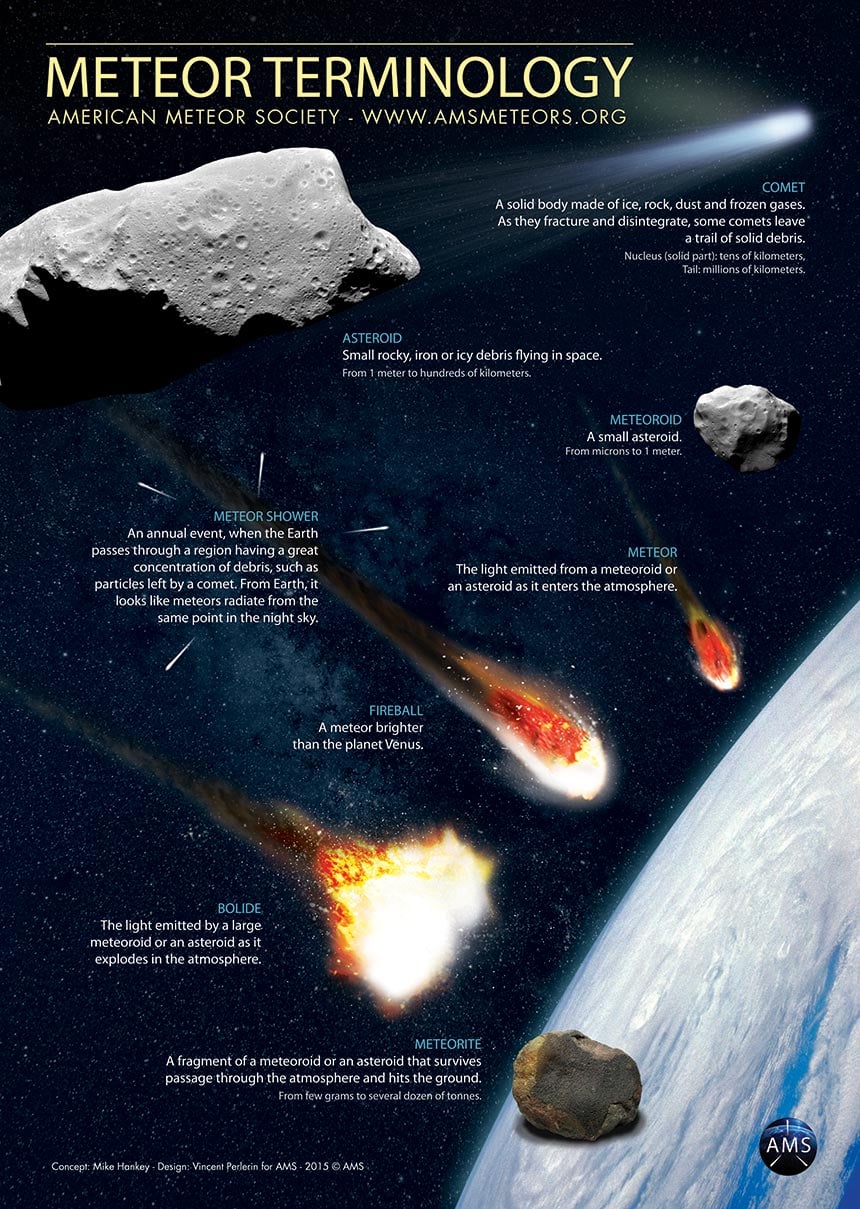
Many of the most extraordinary meteor sightings are fireballs, meteors whose light appears brighter than that of the planet Venus (the brightest object in the sky, excluding the Moon and the Sun, which you can see towards the horizon either after sunset or before sunrise).
For comparison, the one from Chelyabinsk has been dubbed a superbolide due to its extremely high peak luminosity and the fact that it exploded brightly multiple times as it burned in our atmosphere.
Then, the more scientific meteor and the everyday shooting star, in the end, describe the same thing: the light produced by a rock entering the atmosphere. That rock itself, while moving through space, has its own name depending on size: an asteroid is small, rocky, iron, or icy debris ranging from about a meter to hundreds of kilometers across. A meteoroid is smaller, anywhere from a few microns up to one meter.
If any part of a meteoroid survives all the way to the ground, that surviving remnant is called a meteorite, usually fragmented into many pieces of varying sizes.
To summarize, a quick reference:
- Asteroid, small rocky, iron, or icy debris larger than about a meter, up to hundreds of kilometers across.
- Meteoroid, the same kind of object, but smaller, from a few microns up to about a meter across.
- Meteor, the streak of light produced when a meteoroid or asteroid burns up entering the atmosphere. Also called a shooting star.
- Fireball, a meteor whose light is brighter than the planet Venus.
- Bolide, the light produced by a larger meteoroid or asteroid as it explodes in the atmosphere. A superbolide is the most extreme, rarest version of this.
- Meteorite, any fragment that survives the trip through the atmosphere and reaches the ground.
What actually shows up on the instrument trace
When a pressure wave from one of these events reaches the ground, it can be detected in two different ways. If it’s strong enough, like for a larger fireball or a bolide, it will physically shake (couple into) the ground very slightly, showing up as a genuine seismic signal.
More often, and particularly for smaller events, it will register as an atmospheric pressure fluctuation and will be picked up only by infrasound sensors.
Either way, the resulting signature is fairly recognizable once you know what to look for. It’s a short, sharp pulse rather than the drawn-out rumble of a rocket launch or the steady thump-thump-thump of a passing helicopter. On a spectrogram, the energy spreads across a wide range of frequencies at once, like a lightning strike, instead of the tidy, banded frequency lines left by a rotor blade or engine (Figure 2).
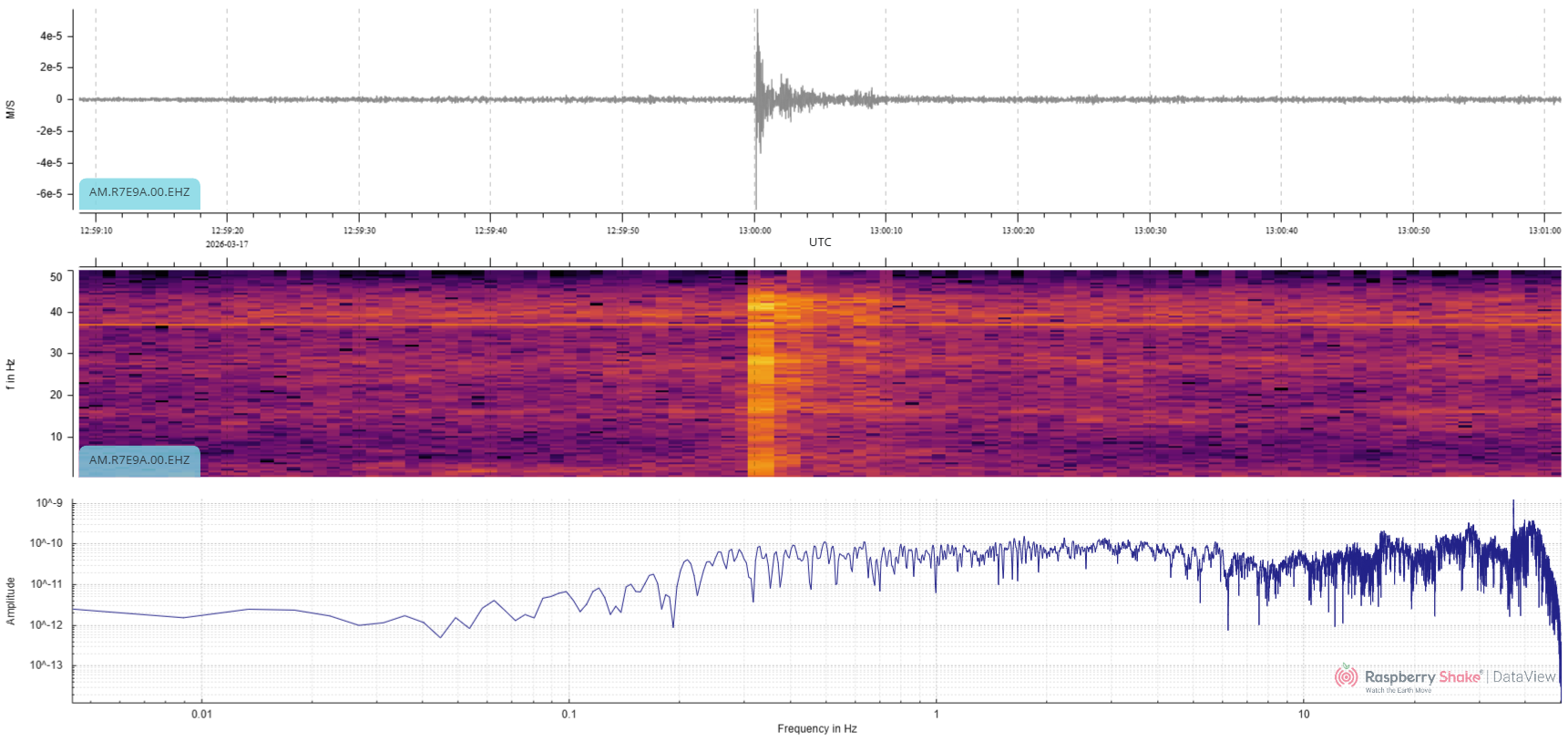
Figure 2: An example of meteor detection in the vertical seismic channel
And, taken from our other recent blog post, Things you might find with your Raspberry Shake – Part 2, here is a practical recommendation for the identification of suspected recorded meteors: such events are logged by dedicated fireball networks (such as the American Meteor Society or the UK Meteor Observation Network), and major events are often reported within hours (or even minutes via social media). Cross-referencing your Shake’s timestamp with these databases is usually the quickest way to confirm an alleged detection, and a very satisfying one when everything lines up and matches the signal in front of you.
The case of 2023CX1
In the case of larger atmospheric entries, it’s highly possible that many stations in a wider area will record the event as the meteor burns up. This is what happened for 2023CX1 back in February 2023.
This particular near-Earth asteroid was notable because it was one of the few that had been spotted and tracked by astronomers and sky observers hours before it entered our atmosphere and broke up over the English Channel in the early hours of the morning.
The European Space Agency also alerted the public via social media before its arrival, once its impact probabilities had been fully validated, resulting in numerous photos of its burn-up.
This also caused many people, myself included, to monitor the closest Raspberry Shakes for a signal of the released pressure wave. And, right on schedule, it reached two infrasound stations SW of Paris about six to seven minutes later.
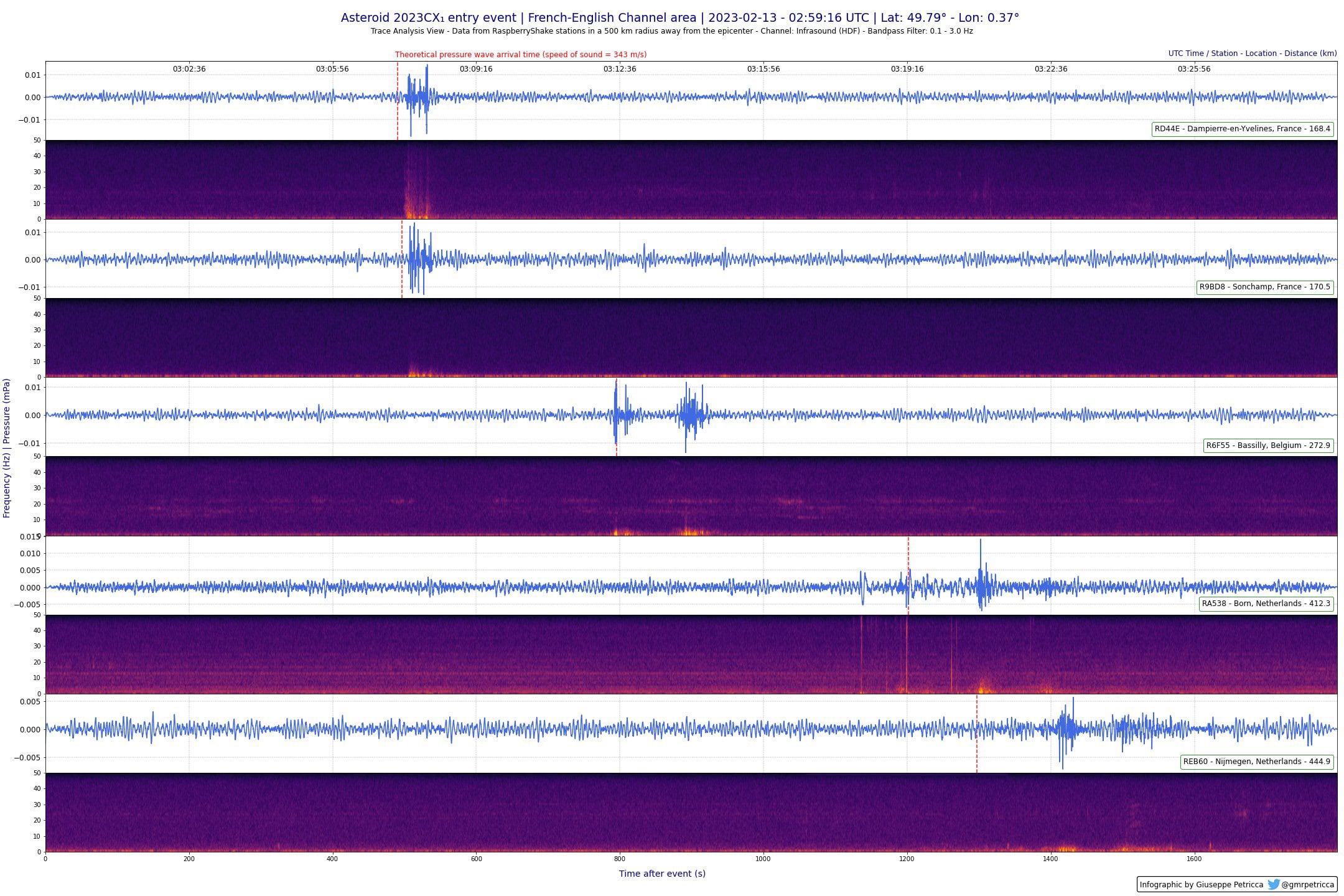
Moreover, a scattering of sensors across Belgium and the Netherlands also recorded the moving pressure wave, as shown in the map in Figure 4, which complements the waveform/spectrogram plot above.
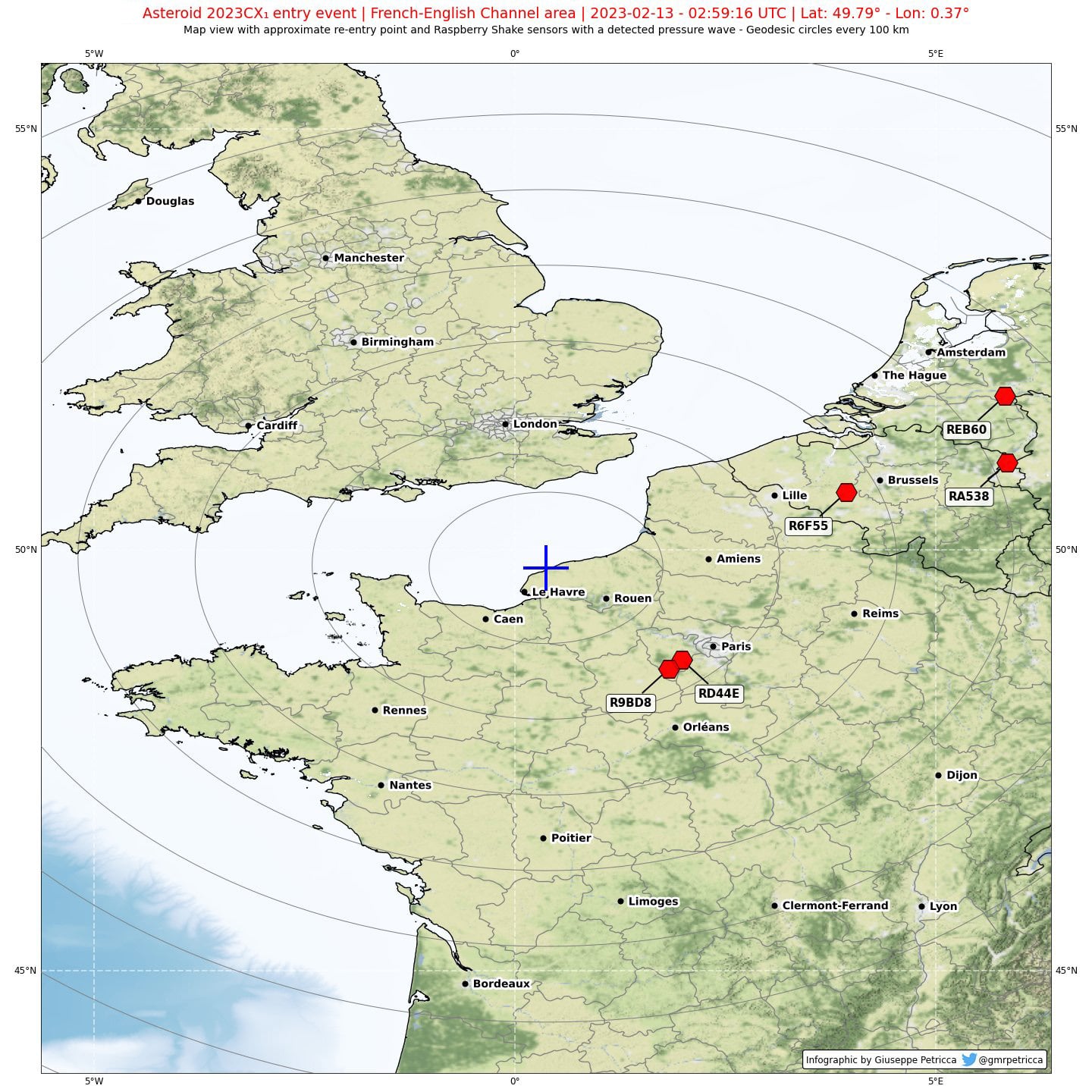
Figure 4: All clear detections from the pressure wave released by 2023CX1
When laid out like this, the detections roughly traced out what you would expect: a sound wave rippling outward from a single point at the speed you would calculate for that altitude and temperature, weakening and arriving progressively later the further it travelled. A regional seismic network in France separately picked up the same shockwave on its instruments, providing two independent confirmations of the same event.
More and more meteors
Not every case follows the same script, which is part of what makes this kind of detective work so interesting and fascinating.
Earlier this year, a fireball broke apart over Cleveland, Ohio, in the United States of America, and it showed up almost identically on two separate sensors. Multiple detections are useful for ruling out a fluke or possible local interference, since the same brief spike appeared on the traces of both sensors at the expected time.
This particular daytime event, visible in Figures 5 and 6, was also detected by the Geostationary Lightning Mapper on the GOES satellites and several cameras in the region. The meteor appeared about 80 km (about 50 mi) over Lake Erie and then travelled about 54 km (about 34 miles) before fragmenting. It was produced by an asteroid of 2 m in diameter (about 6.5 feet) that weighed about 7 tons.
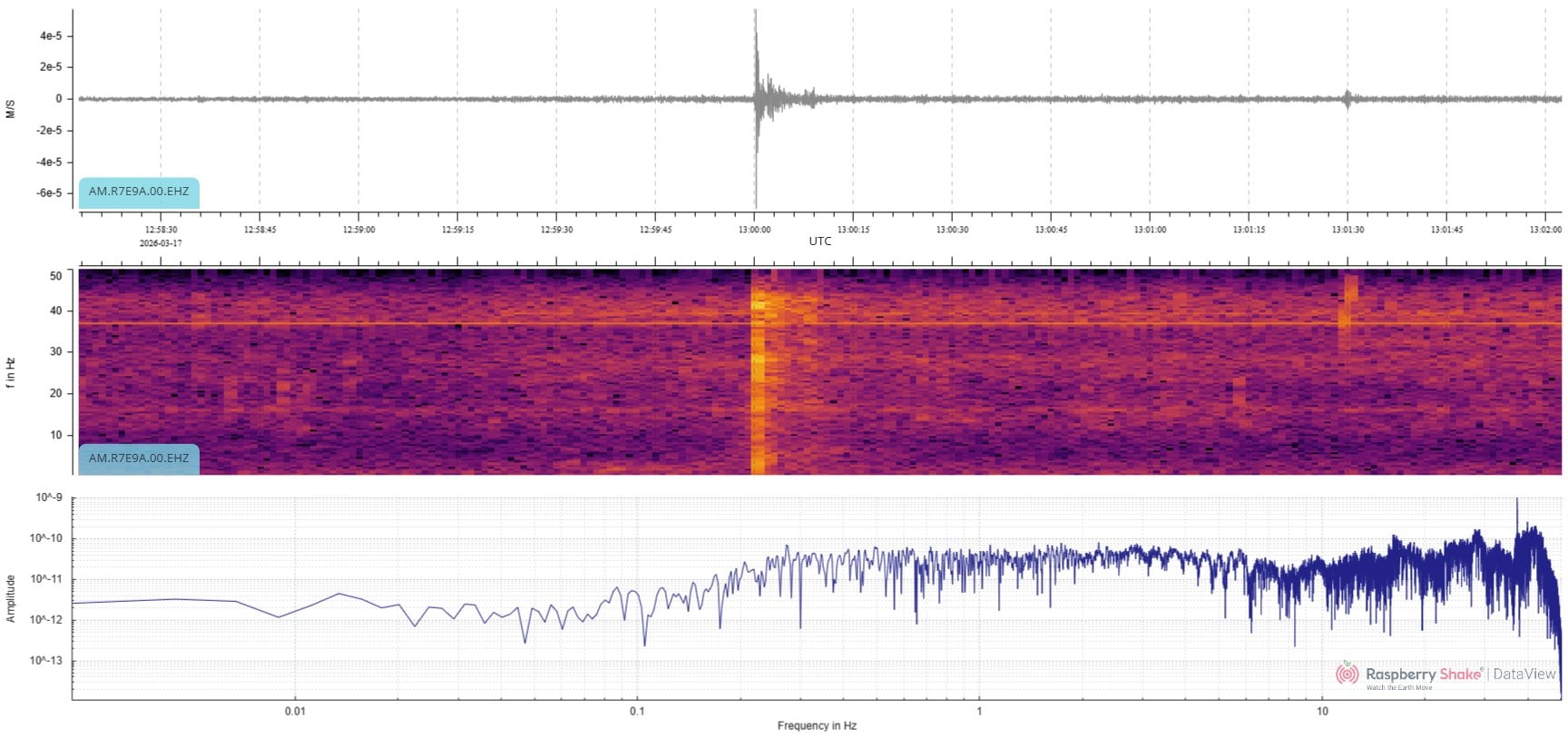
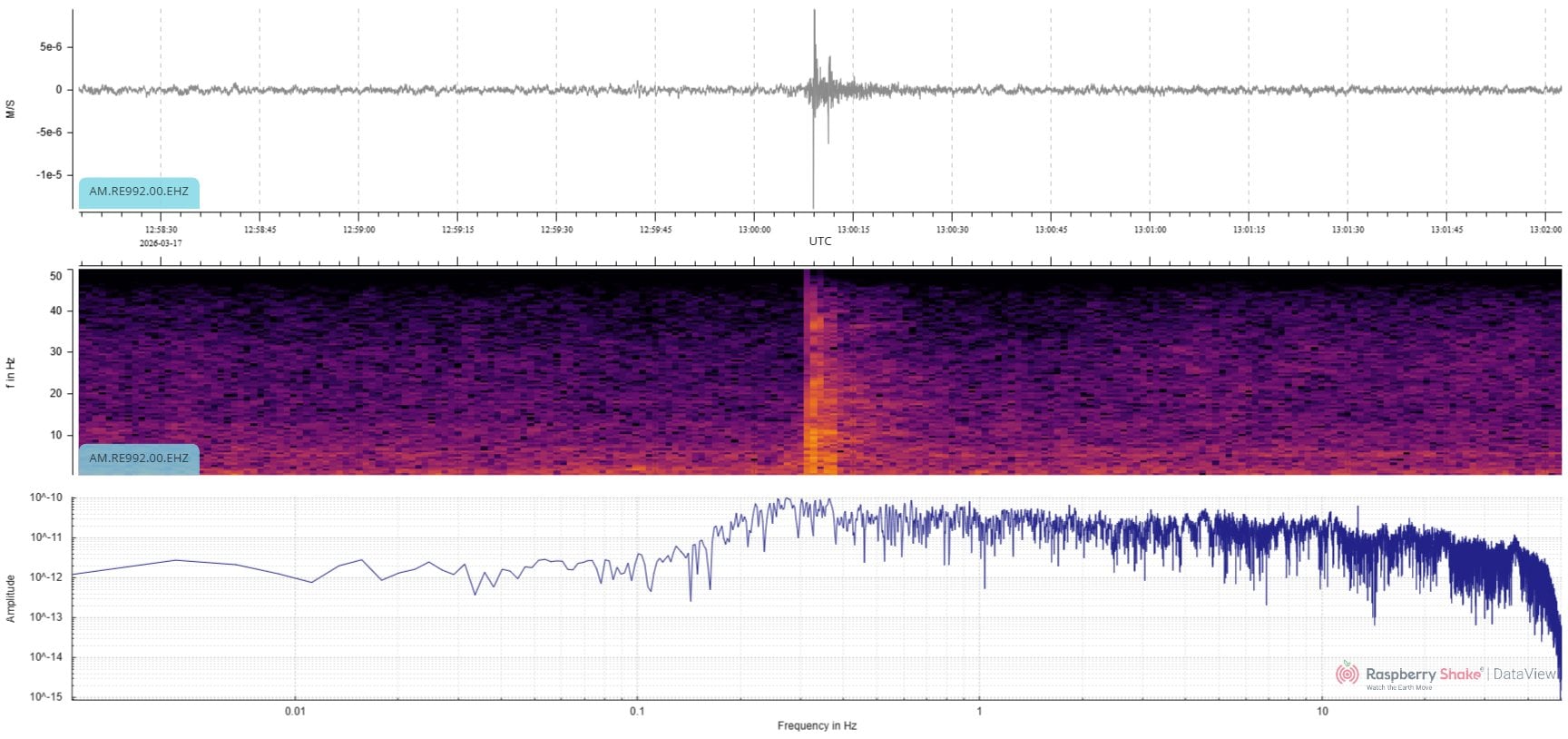
And, during the same month (March 2026), we had even more detections. In Figures 7 and 8 below, we can see a meteor burn-up over western Germany and California.
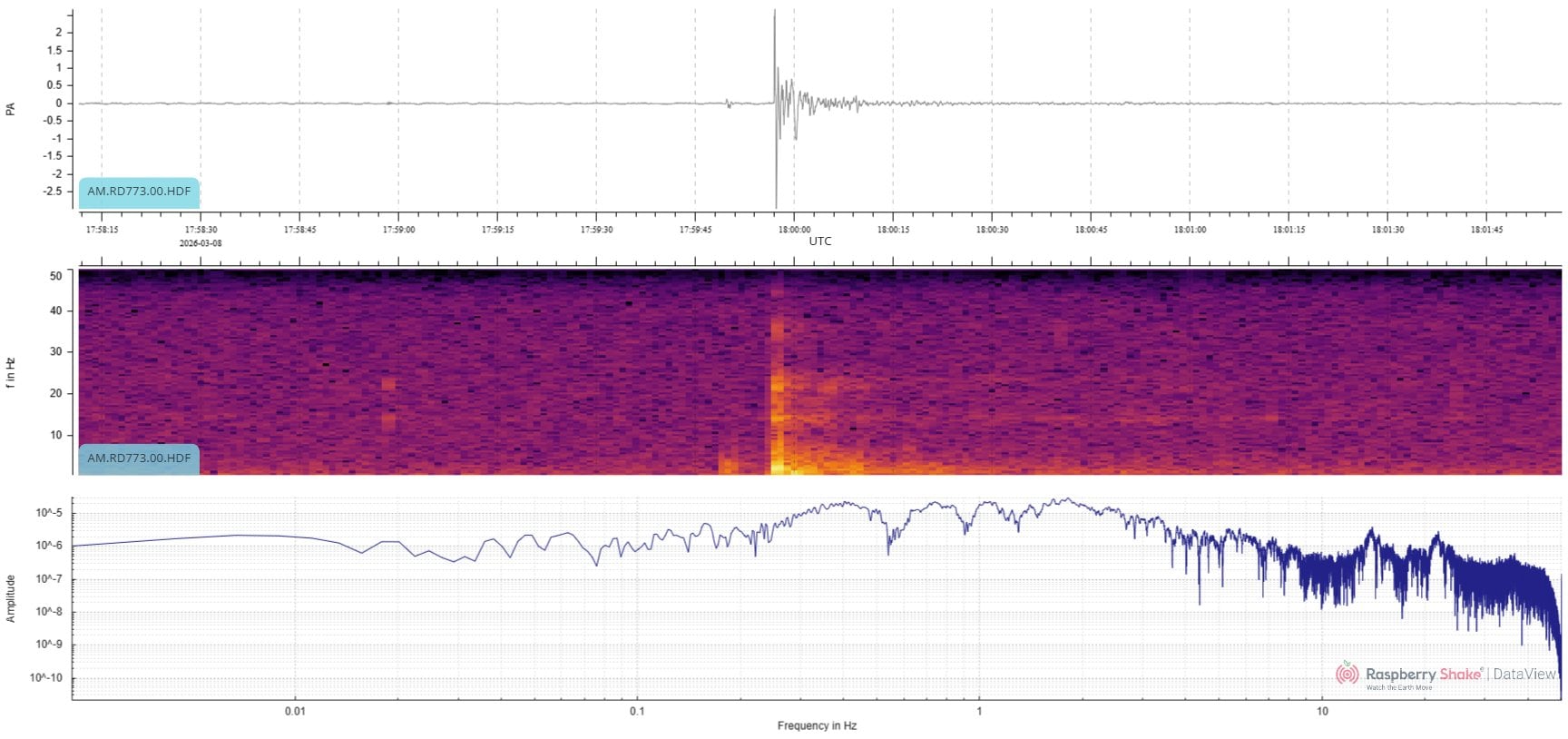
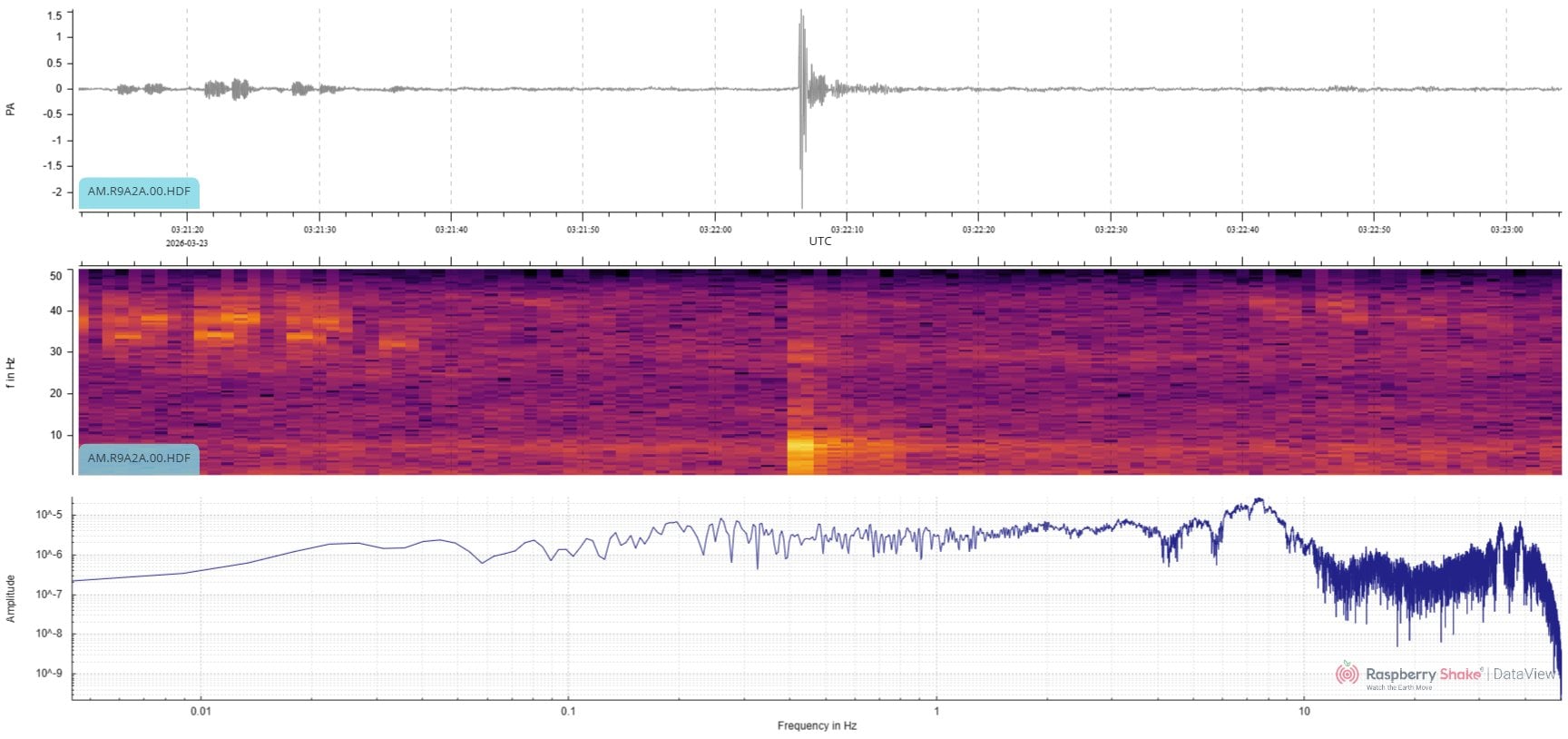
In particular, the German one was recorded around sunset, leaving a beautiful trail in the sky that persisted for quite some time and was pictured by many people between Germany and France.
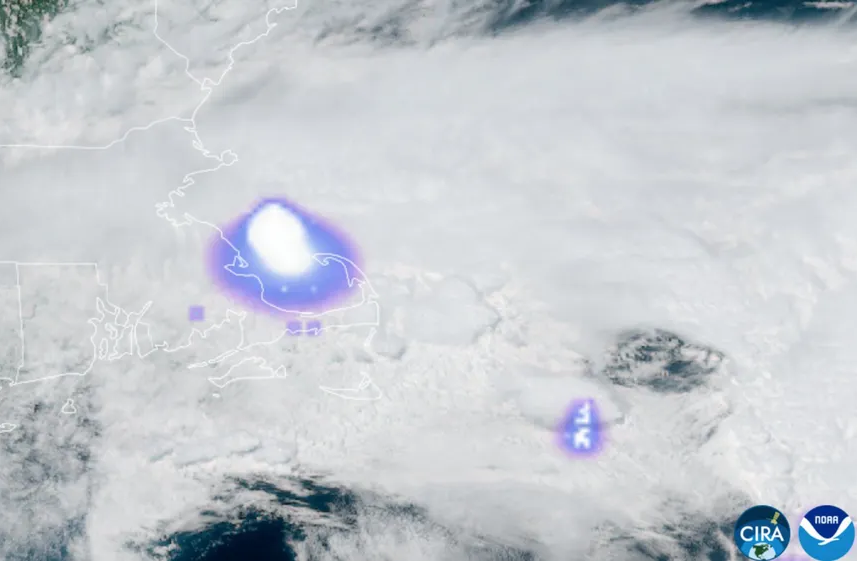
We also had other significant events during the first part of 2026, such as the meteor that exploded off the coast of Massachusetts, USA (Figure 9), which was so intense that it was felt and heard throughout all New England with reported ground shaking.
Fainter events, instead, take more patience to be identified and classified. After a smaller meteor sighting over the Baltic Sea near the Åland archipelago during the summer of 2025, enthusiasts spent much time comparing candidate traces from several nearby stations against the timing of eyewitness footage and entries in fireball databases before settling, tentatively, on which signal actually belonged to the event rather than to wind noise or an unrelated local disturbance.
That habit of checking one source against another is, in practice, how most of these detections get confirmed at all. Dedicated fireball reporting networks log sightings from the public within hours, sometimes minutes, especially in the instantly-available media age in which we live.
Numbers abound
A part of the fun also starts when people use recorded arrival times to work backwards. If you know roughly when and where a flash was seen, and you know the speed of sound, you can estimate how far away, and how high up, the event actually happened.
That’s exactly the case of a bright fireball that lit up the sky over Norway in July 2021. A skywatcher’s camera caught the flash clearly, timed at 23:08:52 UTC, and a check of his Raspberry Shake and Boom infrasound sensor afterwards showed a clear pulse (Figure 10), but at a time that at first looked wrong, arriving at 23:11:29 UTC with a gap of 157 seconds.
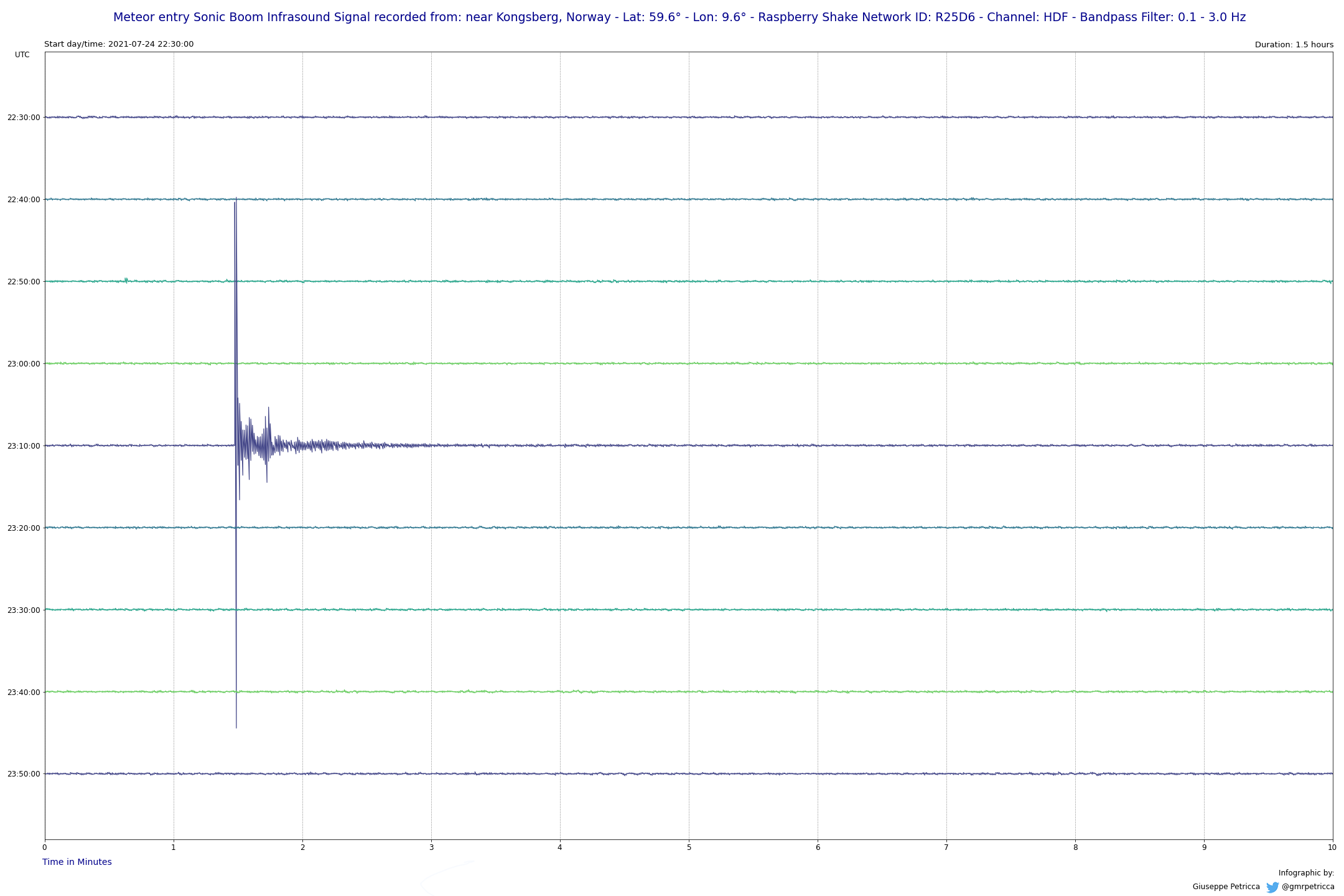
This discrepancy is, in the end, easily explained. Light from the fireball reached the camera almost instantly, while the pressure wave had to physically travel there at roughly 343 meters per second at ground level, much much slower than the speed of light. Dividing that delay by the known speed of sound pointed to a source about 50 kilometres away, which lined up very well with the observer’s own estimate of where the object had come down.
Furthermore, combining that distance with the geometry of the meteor’s path in the sky put the likely altitude of the explosion at around 31 kilometers, consistent with where fireballs typically detonate.
A similar, more rigorously documented calculation played out after a bright meteor over Switzerland in October 2018. Multiple all-sky camera stations there triangulated the object’s full trajectory from start to end: it entered the atmosphere at an altitude of 118 kilometers (about 73 miles), travelling at roughly 38 kilometers per second (about 24 miles per second) on a steep angle before ending in a bright double flash, a sign of the meteoroid fragmenting explosively.
That flash gave observers a convenient single reference point in the sky from which to model an expanding sound wave. Knowing the point’s exact location and time, and using a standard model of how the speed of sound varies with altitude and temperature, researchers calculated when the resulting pressure wave would reach each of several ground stations scattered across the region.
And, when the actual recordings came in, three of the four stations picked up a clear signal within about two seconds of the predicted arrival time, a result the researchers judged accurate to within roughly 620 meters (about 680 yards) over a sound path that had travelled through the atmosphere for several minutes!
Eyes to the sky (and on your instruments)
It’s impossible to predict when and where a fireball will become visible, unless we are able to track its origin meteoroid or asteroid hours in advance. However, some meteor showers, such as the Taurids (visible between the end of October and the start of November), are widely recognized for producing more fireballs than any other annual shower.
And it’s also worth knowing that fireball sightings tend to rise noticeably between February and April, especially around the spring equinox, for reasons not fully understood, which is part of why so many of the examples above landed within weeks of each other in March 2026.
In any case, if you see (and hear) one and you have your own infrasound or seismic sensor (or a Raspberry Shake near you), go and check it because a pressure wave travelling through the atmosphere will be recorded by anything that’s listening at the time!